The Frozen Shoulder Fix
For the shoulder that won't loosen up.
Sound Familiar?
A shoulder that's tight, achy, or flat-out frozen changes more than your workouts. It changes how you sleep, how you reach for something on a shelf, how you throw a ball with your kid.
The Ronin is built to get into that shoulder — and the hip and back tightness that often comes along with it — and start opening it back up. Hit play above and go through it with us.
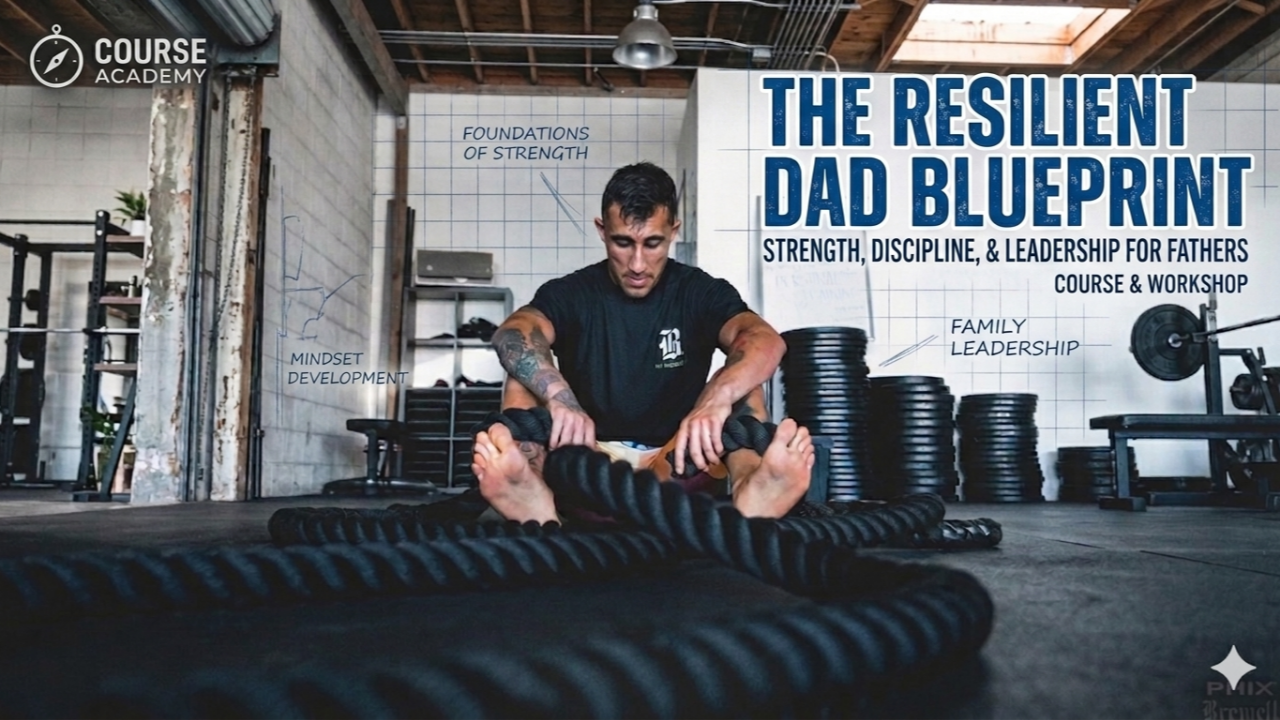
The Ronin is one piece of a much bigger plan to get you out of pain, moving better, and building real strength again. The Dad Blueprint gives you the entire system — every phase, every fix — plus more support if you want it.
- Base — $50/mo: The complete video library. Every workout, every phase, unlimited access.
- Pro — $200/mo: Everything in Base, plus the private community, live weekly Zoom classes, and a free 1-on-1 call for new members.
Here's Where This Fits
The Dad Blueprint is broken into four phases:
- Phase 1: Restoration (Injury & Pain Management) — YOU ARE HERE
Calming down what actually hurts — sciatica, back pain, frozen shoulders — before anything else.
- Phase 2: The Reset (Back 2 Basics)
Rebuilding the fundamental movement patterns your body forgot it had.
- Phase 3: The Build (Smart Lifter's Guide)
Real strength and conditioning again — safely, without waking up old injuries.
- Bonus Phase: The Unlock (Rotational Strength)
Athletic, rotational power and a bulletproof core.
UP NEXT: The Boa Constrictor — for building an athletic, bulletproof core.
BEFORE YOU START
What You'll Need
- A cable machine
- A single cable handle attachment
Setup
- Set the cable to the highest setting and attach a single handle.
- Choose a weight heavy enough that you can row it with one arm and feel it pulling your body forward — not so light that you don't feel any resistance.
- Drop into a half-kneeling stance. If you're gripping the cable with your left hand, your right leg comes forward, pointed at the cable machine. Your back leg (left) points out to the side — think an “L” shape (or a “V,” depending who you ask).
- Once you're down, open both knees. You should feel it through your inner thighs, and your glutes should be doing the work to keep you stable — don't just lift your toes to fake the position.
- Shift your weight onto that front leg and drop your elbow down onto it. That's your starting position before you pull.
Execution
- Pull the handle up to about your ribs.
- On the way back, push your knees open and push your hips away from the cable machine with your lower body. You'll feel a big stretch down your whole side — that's the part to chase.
- Pull again — don't let your hips drift forward on the pull.
- As you pull up this time, twist and look underneath your armpit. You'll get a deeper stretch than you did on the first rep.
- Keep chasing a little more range each rep — a little further, a little deeper, every time.
What This Undoes
- Your shoulder — so reaching overhead, throwing with your kid, and sleeping on that side stop being a problem.
- Your lower back — so standing up from the couch, the car, or your desk chair doesn't come with a groan.
- Your hips and inner thighs — so getting down on the floor with your kids (and back up again) isn't a whole production.
“Don't worry if your reps or your range don't look like mine. Do what you can with your body — and chase the opening, not the weight.”
Sets & Reps
2 sets × 6–8 reps per side.
Caution: Dealing with knee pain or more serious hip pain? Skip this one and move on to the next exercise in your program instead.
Medical Disclaimer: The Homelander Challenge is provided for educational and informational purposes only and is not intended to replace medical advice, diagnosis, or treatment. Always consult your physician or another qualified healthcare provider before beginning this or any exercise program, especially if you have pain, a current or previous injury, or a medical condition. Perform all movements within a pain-free range of motion. If you experience sharp pain, dizziness, numbness, or any other concerning symptoms, stop immediately and seek appropriate medical care. By participating in this challenge, you acknowledge that you are voluntarily engaging in physical activity and assume all associated risks.